What is a Sewage Treatment Plant (STP) and How Does It Work? Process, Benefits & Applications
Water is one of the most valuable resources on Earth, yet increasing urbanization, industrialization, and population growth are placing immense pressure on freshwater supplies. Every day, homes, apartments, hotels, industries, hospitals, and commercial establishments generate large quantities of wastewater. If this wastewater is released untreated into the environment, it can contaminate rivers, lakes, groundwater, and public water systems.
A Sewage Treatment Plant (STP) is designed to solve this challenge by treating wastewater and converting it into reusable water that meets environmental standards.
Many people search for what is a sewage treatment plant and how does it work, especially when planning residential, commercial, or industrial projects. Understanding the sewage treatment process can help property owners, builders, facility managers, and industries make informed decisions regarding wastewater management.
At Indus Ecowater, we provide advanced sewage treatment solutions that help organizations reduce water consumption, comply with environmental regulations, and contribute to a sustainable future.
This detailed guide explains everything you need to know about sewage treatment plants, including their working process, technologies, benefits, applications, and how to choose the right STP for your project.
What is a Sewage Treatment Plant (STP)?
A Sewage Treatment Plant is an engineered system designed to remove contaminants, pollutants, suspended solids, and harmful microorganisms from wastewater.
The treated water can then be safely:
- Reused for non-potable applications
- Discharged into the environment
- Used for irrigation and landscaping
- Utilized in industrial processes
An STP plays a crucial role in modern infrastructure by ensuring that wastewater is treated efficiently before it re-enters the environment.
Sources of Sewage
Sewage typically originates from:
- Residential apartments
- Villas and housing societies
- Hotels and resorts
- Shopping malls
- Hospitals
- Educational institutions
- Industrial facilities
- Municipal sewage networks
Without treatment, this wastewater contains harmful pollutants that can cause environmental degradation and public health risks.
Why is Sewage Treatment Important?
Protecting Natural Water Resources
Untreated wastewater often contains:
- Organic pollutants
- Suspended solids
- Pathogens
- Nutrients
- Harmful chemicals
These contaminants can pollute rivers, lakes, ponds, and groundwater sources.
Sewage treatment ensures these pollutants are removed before discharge.
Improving Public Health
Contaminated water is a major source of disease transmission.
Proper wastewater treatment helps reduce:
- Cholera
- Typhoid
- Dysentery
- Hepatitis
- Gastrointestinal infections
This contributes significantly to healthier communities.
Supporting Sustainable Water Management
Water scarcity is becoming a serious concern in many regions.
Treated wastewater can be reused for:
- Gardening
- Landscaping
- Toilet flushing
- Cooling towers
- Industrial operations
This reduces freshwater consumption and promotes sustainability.
Ensuring Regulatory Compliance
Government authorities require wastewater treatment before discharge.
Installing a Indus Ecowater STP helps organizations:
- Meet CPCB norms
- Avoid environmental penalties
- Improve ESG performance
- Achieve sustainability goals
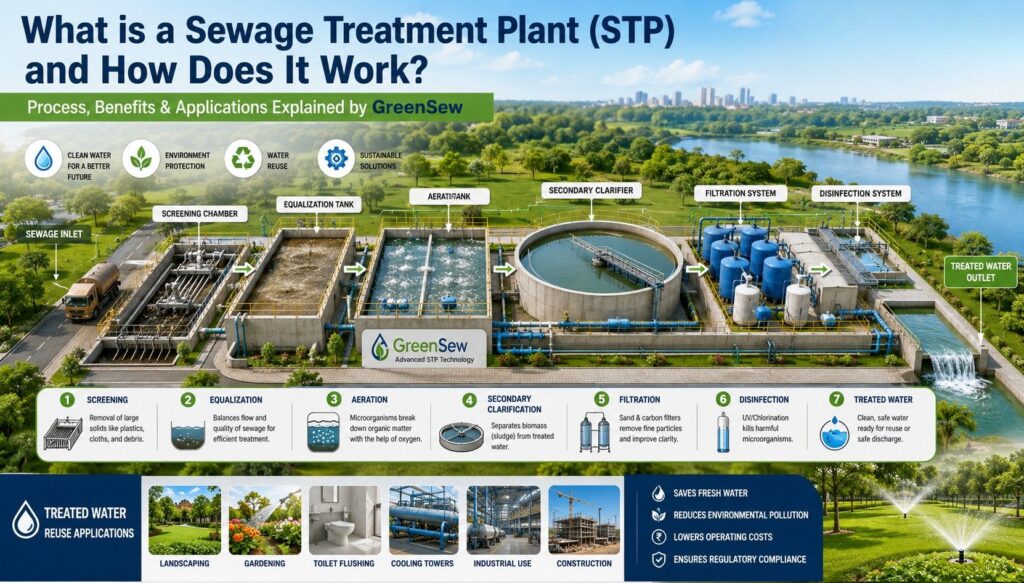
Sewage Treatment Plant Process Step by Step Explained
One of the most searched topics is sewage treatment plant process step by step explained.
The treatment process typically includes the following stages:
1. Collection of Sewage
Wastewater is collected through underground drainage systems and conveyed to the treatment facility.
The incoming wastewater may contain:
- Organic matter
- Oils and grease
- Soap residues
- Suspended solids
- Pathogenic microorganisms
2. Screening Process
The first stage removes large debris such as:
- Plastic bags
- Cloth
- Wood
- Bottles
- Paper waste
Screening protects downstream equipment from damage.
3. Equalization Tank
The Equalization Tank balances fluctuations in wastewater flow and quality.
Benefits include:
- Stable operation
- Improved treatment efficiency
- Reduced shock loading
4. Primary Treatment
In this stage:
- Heavy solids settle at the bottom
- Floating materials rise to the surface
- Sludge is separated
Primary treatment significantly reduces suspended solids.
5. Biological Treatment
This is the most critical stage of wastewater treatment.
Beneficial microorganisms consume:
- Organic matter
- Nutrients
- Dissolved pollutants
The biological process converts contaminants into harmless by-products.
This stage is responsible for substantial reductions in:
- BOD
- COD
- Organic pollution
6. Secondary Clarification
The mixed liquor from the aeration tank enters a clarifier.
Here:
- Biomass settles
- Clear water separates
- Sludge is removed
The clarified water proceeds for advanced treatment.
7. Tertiary Treatment
Tertiary treatment improves water quality further.
This may include:
Pressure Sand Filter
Removes fine suspended solids.
Activated Carbon Filter
Removes:
- Color
- Odor
- Organic traces
Advanced Filtration
Provides additional polishing when high-quality treated water is required.
8. Disinfection
Pathogens are eliminated using:
- UV systems
- Chlorination
- Ozonation
This ensures microbiological safety.
9. Treated Water Storage and Reuse
The final treated water is stored for reuse applications such as:
- Landscaping
- Flushing
- Cooling systems
- Industrial operations
Main Components of a Sewage Treatment Plant
A modern Indus Ecowater STP includes:
Screening Chamber
Removes large debris.
Equalization Tank
Balances incoming flow.
Aeration Tank
Supports biological treatment.
Clarifier
Separates solids from treated water.
Filtration System
Improves water quality.
Disinfection Unit
Eliminates microorganisms.
Sludge Handling System
Manages generated sludge safely.
Pumps and Blowers
Support water movement and aeration.
Advanced Sewage Treatment Plant Technology for Wastewater Reuse
Modern projects increasingly require advanced sewage treatment plant technology for wastewater reuse.
Several technologies are available depending on project requirements.
MBBR Technology
Moving Bed Biofilm Reactor technology uses specially designed bio-media.
Advantages:
- Compact design
- Low maintenance
- High efficiency
- Stable performance
SBR Technology
Sequencing Batch Reactor technology performs treatment in timed cycles.
Advantages:
- Excellent effluent quality
- Smaller footprint
- Better nutrient removal
MBR Technology
Membrane Bioreactor systems combine biological treatment with membrane filtration.
Advantages:
- Exceptional water quality
- High reuse potential
- Compact footprint
Hybrid Biological Systems
Indus Ecowater utilizes advanced hybrid systems combining multiple treatment principles.
Benefits include:
- Improved treatment efficiency
- Lower energy consumption
- Better process stability
- Superior treated water quality
Benefits of Installing a Sewage Treatment Plant for Apartments
One of the most common searches today is benefits of installing a sewage treatment plant for apartments.
Water Reuse
Apartments can reuse treated water for:
- Gardening
- Flushing
- Landscaping
This significantly reduces freshwater demand.
Reduced Water Bills
Water recycling decreases dependency on municipal and tanker water supplies.
Regulatory Compliance
Many local authorities require residential projects to install STPs.
Environmental Responsibility
Apartment communities can reduce their environmental footprint through wastewater recycling.
Increased Property Value
Sustainable infrastructure is becoming a major factor in property valuation.
Applications of Sewage Treatment Plants
Residential Sector
- Apartments
- Villas
- Housing societies
- Townships
Commercial Sector
- Hotels
- Resorts
- Shopping malls
- Office buildings
Industrial Sector
- Manufacturing facilities
- Processing plants
- Industrial parks
Institutional Sector
- Schools
- Colleges
- Universities
- Hospitals
Municipal Sector
- Urban infrastructure
- Smart cities
- Public sewage networks
How to Choose the Right Sewage Treatment Plant for Commercial Buildings
Another important long-tail keyword is how to choose the right sewage treatment plant for commercial buildings.
Consider the following factors:
Capacity
Determine daily sewage generation in KLD.
Space Availability
Compact systems may be required in urban areas.
Water Reuse Requirements
Identify intended reuse applications.
Compliance Standards
Ensure adherence to CPCB norms.
Energy Consumption
Evaluate long-term operational costs.
Maintenance Requirements
Select technologies that match operational capabilities.
Future Expansion
Choose scalable systems capable of handling future growth.
Why Choose Indus Ecowater Sewage Treatment Plants?
Indus Ecowater provides modern wastewater treatment solutions engineered for performance, sustainability, and reliability.
Key Advantages
✔ Advanced biological treatment
✔ High-quality treated water
✔ Energy-efficient operation
✔ Compact footprint
✔ CPCB-compliant performance
✔ Low maintenance
✔ Modular and scalable design
✔ Long operational life
✔ Expert engineering support
✔ Customized project solutions
Frequently Asked Questions
What is a sewage treatment plant and how does it work?
A sewage treatment plant removes contaminants from wastewater through screening, settling, biological treatment, filtration, and disinfection before reuse or discharge.
What is the lifespan of an STP?
A properly maintained STP can operate efficiently for 20–30 years or more.
Can treated water be reused?
Yes. Treated water can be reused for flushing, gardening, cooling towers, and industrial processes.
Which STP technology is best?
The ideal technology depends on capacity, space, water quality requirements, and operating conditions. MBBR, SBR, MBR, and hybrid systems are among the most widely used options.
Is an STP mandatory for commercial projects?
Many regulatory authorities require commercial developments to install wastewater treatment systems.
Conclusion
A Sewage Treatment Plant (STP) is one of the most important components of sustainable infrastructure. Whether for apartments, commercial buildings, industries, institutions, or municipalities, wastewater treatment helps protect the environment, conserve water resources, and ensure regulatory compliance.
Understanding what is a sewage treatment plant and how does it work enables project owners to make informed decisions regarding wastewater management. With advanced treatment technologies, treated water can be safely reused, reducing dependence on freshwater sources while lowering operating costs.
Indus Ecowater delivers reliable, energy-efficient, and environmentally responsible sewage treatment solutions designed to meet modern wastewater treatment challenges. From compact residential systems to large-scale industrial and municipal installations, Indus Ecowater helps organizations transform wastewater into a valuable resource while building a cleaner and more sustainable future.